Search This Blog

24 April 2009

Be a Risk Taker & Trust the Riskbreaker


You know how it is. You start writing something that then loses its fire. Well, here's a post that began like that a few weeks ago (3-31-09) and then reignited today. I hope it blesses you.

Oh, the title is partially a shout out to my good friend -- Stewart Bertram.

Psalm 20:7-8, "Some trust in chariots, and some in horses: but we will remember the name of the LORD our God. They are brought down and fallen: but we are risen, and stand upright."

There are some who have traded their trust in God for that which they've made with their own hands. They trust in chariots and are more confident in human talent, philosophy, and ability than in the provision and strength of the Lord.

They trust in human sufficiency and abort God's will by their doubt and forgetfulness. They trust in their own ideas and manufacture scenarios thinking their finite understanding better than the infinite wisdom of the LORD.

They use the policies of the world to obtain that which can only come by the proven principles of the Word of God. They invent strategies without prayer and forget (or ignore) to call upon God. They’ve forgotten His name, fame, and reputation. What He's done and what He wants takes a backseat to what these purveyors of self foist onto the good and trusting flock of God.

Lack of trust is evident by their preoccupation with what they can form, cultivate, or influence. Afraid to show faith in something outside of themselves they resist what they don't understand and grasp onto that which is temporal, known, and comfortable.

Isaiah 31:1, “Woe to them that go down to Egypt for help; and stay on horses, and trust in chariots, because they are many; and in horsemen, because they are very strong; but they look not unto the Holy One of Israel, neither seek the LORD!"

Some have forgotten the freedom and liberty that comes with trust in God and have traded that assurance for the illusion of control. They’ve trusted in horses. They trust in what they think they can direct. Their attempt at control and manipulation is a mirage. The only control they have is the choice to trust in God, or to trust in their own frail human ways.

I was with Pastor Edwin S. Harper for a few days this week. He asked me this question (once asked of him), "How do you spell faith?" My first thought was the predictable one, "F-A-I-T-H," but he said, "Faith is spelled R-I-S-K."

RISK! You get nowhere in life without taking a risk. The four bearers of the Ark of the Covenant took a risk by stepping out into the Jordan, but their risk was rewarded with the miraculous parting of the waters, and, as I heard Buddy Buie say recently, "When they stepped into the Jordan their feet kicked up the dust in the dry riverbed." God doesn't just answer prayer, He goes the extra mile in displaying His majesty as He works on your behalf.

It is easy to sometimes be paralyzed by the need to know for sure what a decision will bring to pass before we do something, but this is not faith. Faith is taking God at His Word and risking everything of comfort for uncertainty.

The wonderful thing about taking a risk on God is that it's not really a risk. We need to quit forgetting about His reputation, fame, and reputation. Recall the power resident in His name, the name of Jesus.

Next time you are thinking of taking a risk remember the true Riskbreaker and personalize these words: "Be strong and of a good courage, fear not, nor be afraid of them: for the LORD thy God, he it is that doth go with thee; he will not fail thee, nor forsake thee" (Deut. 31:6).

23 April 2009

Bishop Norman Wagner - Praise God

I'm really feeling this song tonight. In fact, all day long I've had this feeling of praise and thankfulness in my soul.

Remember, even in the midst of a wicked and perverse generation, where the heathen and ungodly are presented as paragons of virtue calling good evil and evil good, God is still present and in control. He is worthy to be praised!

16 March 2009

Pamphlets from Oneness Pentecostal Writers (Part 1)


I spent the weekend in South Bend, IN at my grandmother's home (Helen v. Kuntzman).

As is my custom when I'm there, I spent a considerable amount of time in my grandfather's library looking, reading, and studying his collection.

My grandfather (Rev. E. E. Kuntzman) was an Apostolic preacher and went to his eternal reward many years ago. I treasure the library he left behind and the notes he jotted in books, pamphlets, Bibles, and sermons. They are always a blessing to me and their truths are ageless.

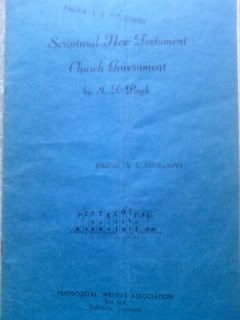
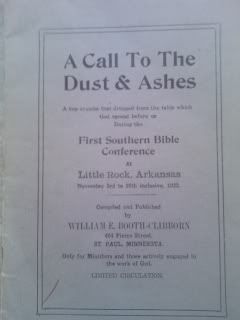
My grandparents have several books and pamphlets written by, or about, some of our early pioneers and proponents of the Oneness Pentecostal message. While I didn't take pictures of them all, the ones above are what I read this weekend.

20 February 2009

Nothing Can Separate (Part I) Bishop James A. Johnson

One of my favorite preachers preaching about the intercession of Christ and the impossibility of being separated from His love.

29 January 2009

The Quantum Leap


Today I am posting an article written by Leon Golden. Leon is a senior at IUPUI pursuing a Bachelor of Science in Mechanical Engineering, a member of Moriah Apostolic Church, and one of my dearest friends.


The Quantum Leap
By: Leon Golden

The rapture, the catching-away, the Lord’s return for His saints, whatever you choose to call it, Christians have been eagerly anticipating this day for nearly two-thousand years. A day when the bodies of those who have truly served God will be instantaneously changed from their natural, physical state, to another “glorious” structure. When you stop and ponder the idea of the rapture, as I will call it, it does appear to be a somewhat ridiculous idea. Many church denominations have given up the idea of a literal “rapture” and viewed the Bible through more humanistic eyes. However, the idea may not be as farfetched as it initially appears. It is this author’s belief that the natural world offers models as well as clues as to the nature and mind of God, bearing in mind that we ourselves are fearfully and wonderfully made. Let’s observe a phenomenon recently discovered (within the last 75 years) by scientists, known as the quantum leap.


Requisite Knowledge


Scripture for consideration: Through faith we understand that the worlds were framed by the word of God, so that things which are seen were not made of things which do appear. (Hebrews 11:3)


The physical things that we see are made up of cells, which can be reduced to individual molecules, which can be further decomposed into atoms. The atom is the smallest elementary unit in which a substance can be broken down into and still retain its identity. In the center of the atom there is the nucleus about which the electrons orbit at an incredible speed. The electron is held in orbit by an electromagnetic force which keeps it as close to the nucleus as its energy will allow it to get. For example, the more energy an electron possesses, the further it can orbit from the nucleus. Only a certain number of electrons can orbit a given energy level, after which they must move to a higher level – in general, the lower energy levels must be filled first.


The concept of a quantum leap stems from the field of quantum mechanics, which is the branch of science that studies the motion and behavior (the mechanics) of atoms.


Nearly every crevice of the universe is constantly bombarded by electromagnetic radiation (light). As this radiation interacts with the electrons, which are the building blocks of matter, some amazing things happen. The electrons absorb and release little “packets” of energy as they interact with the electromagnetic radiation. Of course, as the electron momentarily absorbs this energy, it moves temporarily to a higher energy level and subsequently moves back to a lower energy level as it releases this “borrowed” energy. It is this interaction that commands awe and produces the phenomena called the quantum leap.


Consider the following illustration: If you want to get from your house to the end of the driveway, there is a period of transition, i.e. you must walk from point A to point B. There is a short period of time in which you are between the two places. In contrast, as the electrons absorb and release energy, there is no transition. The electron in the lower energy level “pops” out of existence and instantaneously “pops” into existence at the higher energy level – this is known as a quantum leap.


This concept is a perfect natural model of the rapture of the Church. It does appear to be a completely ridiculous idea, but is nonetheless truth. One day, we will “pop” out of existence on this earth and instantaneously “pop” into existence at a higher energy level.

29 December 2008

Four P's of Perpetual Growth


It's been a while since I posted here and although I've been remiss it seems that many still arrive here to view the Oneness v. trinitarian Debates, or C.P. Kilgore's Wheel of Prophecy, or one of the other blogs on here. I hope you've all been blessed and will continue to visit. I also trust you are all well and find yourself right in the middle of the biggest thing God has ever done in, and through, you. I believe that 2009 will be a great year for the Church and am looking forward it. That being said...


A few weeks ago a friend of mine, T.A. Main (keep an eye on him - - his name will be in lights some day), asked me the following question: "What do you think are the three steps to revival?" He had an interesting list and shared it with me.

At the time I was in a rush and didn't have time to adequately respond to him. It was later in the day that I remembered something the Lord showed me over a year ago concerning sustained growth in our local churches.

Since this is traditionally the time of year when we prepare for the coming New Year I thought I'd post those thoughts for you all today.

I think that there are four key steps to effective and prolonged growth (what some might call "revival") in the local Church and its surrounding communities.

The psalmist wrote, "He that goeth forth and weepeth, bearing precious seed, shall doubtless come again with rejoicing, bringing his sheaves with him" (Ps. 126:6). In this verse we find the Four P's of Perpetual Growth:

1. Prayer

Prayer sets the stage for the miraculous. Prayer is inextricably tied to spiritual growth, whether it is in the individual's life or in the Church. People who pray consistently and persistently with passion will see results from their time with the Lord. Prayer takes discipline and consecration (not to be confused with concentration) but it is the conduit through which Heaven is reached. When we pray we not only speak to God, but He speaks to us. Prayer sets the stage for the miraculous.

2. Praise

Praise sets the atmosphere for the miraculous. Those who have learned to praise God in everything eventually attain a level of spiritual maturity found only in praise. There are various methods of praise but only one way to praise. We must praise God with our whole heart. A whole heart is one that's affections are not divided. True praise is authentic and sold out to Christ alone.

3. Preaching

Preaching is the anointed message of the miraculous Gospel of Jesus Christ. Truly anointed preaching presents Jesus in such a way that people ask the same question asked so long ago on the day of Pentecost and they receive that same anointed answer: "Now when they heard this, they were pricked in their heart, and said unto Peter and to the rest of the apostles, Men and brethren, what shall we do? Then Peter said unto them, Repent, and be baptized every one of you in the name of Jesus Christ for the remission of sins, and ye shall receive the gift of the Holy Ghost" (Acts 2:37-38).

4. Personal Evangelism

Personal evangelism is passion for the miraculous. Personal evangelism is that element of inner passion and expectation that propels people to go and tell others about Jesus and what He's doing today. It is spiritually mature and excellent practice to be a witness of the oneness of God. It is not something that only new converts should be doing. The longer one is in the Church the more they should be going forth to bring in a harvest of souls.

There is more that I could write about for each of these, but the main point is that as we end this old year and look to the new one, let's strive to be praying, praising, preaching, and personally evangelizing our communities. If we follow these steps, I'm convinced (and 29 years of living for God has given me some understanding) that we will experience sustained perpetual growth in our personal lives, our churches, and our communities this coming year – perpetually!

07 June 2008

Take Me Back


I was reminded of the old (1975) Andre Crouch song "Take Me Back" the other night during the altar service at Landmark Apostolic Bible Church in Rockport, IN.

Nobody sang the song at that time; it just came to my remembrance. So often in my life it's been these older songs that I grew up hearing and singing, which resonate deep in my spirit. Here are the words that still speak to me:

Take Me Back
-Andre Crouch

Take me back,
Take me back, dear Lord,
To the place,
Where I first received You.
Take me back,
Take me back, dear Lord,
Where I first believed.

I feel that I'm so far from You Lord,
But still I hear You calling me.
Those simple things,
That I once knew,
The memories are drawing me.

I must confess, Lord, I've been blessed,
But yet, my soul’s not satisfied.
Renew my faith,
Restore my joy,
Then dry my weeping eyes.

I tried so hard
To make it all alone
I need Your help
Just to make it home.


Today, and every day, we need to renew our relationship with God. He is looking for an authenticity from us based on a continuing renewal of the fervor we first had at our initial conversion. The simplicity of our faith and our humility combined with the simplicity of the Gospel resulted in an authentic conversion.

The words “renew my faith, renew my joy, then dry my weeping eyes” is a call get back to the place where we first gave our will to God.

What is it about us that having come to Jesus empty-handed and totally dependent upon him we now, after being “in the Church” for some time, think we can somehow do it all on our own?

I think that there are many people, especially in their 20s and 30s, that received an initial conversion experience at a young age (6-10), but did not really get converted until later, when they were more mature. This may be why we have trouble in our young adults at times. They got the Holy Ghost at a young age, but the Holy Ghost did not get them until they were older.

It is amazing to me to witness the blessing of God on us and yet we are not satisfied in our relationship with Him because of our own self-sufficiency, pride, and vain living. It is a crutch – a trap of the enemy and the flesh to alienate us from intimacy with Jesus Christ, not a “Jesus is my boyfriend” type of intimacy that we are constantly barraged with in this self-absorbed culture we live in, but a closeness that comes from a genuine relationship with our Savior – a relationship that is deepened every day in the good and the bad that life throws at us.

C. S. Lewis addressed the purpose of tribulation in his book The Problem of Pain in this way:

My own experience is something like this. I am progressing along the path of life in an ordinary contentedly fallen and godless condition, absorbed in a merry meeting with my friends for the morrow or a bit of work that tickles my vanity to-day, a holiday or a new book, when suddenly a stab of abdominal pain that threatens serious disease, or a headline in the newspapers that threatens us all with destruction, sends this whole pack of cards tumbling down.

At first I am overwhelmed, and all my little happinesses look like broken toys. Then, slowly and reluctantly, bit by bit, I try to bring myself into the frame of mind that I should be in at all times. I remind myself that all these toys were never intended to possess my heart, that my true good is in another world and my only real treasure is Christ. And perhaps, by God's grace, I succeed, and for a day or two become a creature consciously dependent on God and drawing its strength from the right sources. But the moment the threat is withdrawn, my whole nature leaps back to the toys: I am even anxious, God forgive me, to banish from my mind the only thing that supported me under the threat because it is now associated with the misery of those few days. Thus the terrible necessity of tribulation is only too clear. God has had me for but forty-eight hours and then only by dint of taking everything else away from me.

Let Him but sheathe that sword for a moment and I behave like a puppy when the hated bath is over - I shake myself as dry as I can and race off to reacquire my comfortable dirtiness, if not in the nearest manure heap, at least in the nearest flower bed. And that is why tribulations cannot cease until God either sees us remade or sees that our remaking is now hopeless.


Our problem is that we become desensitized to those “Take Me Back” moments and even brush them aside when God calls us to some personal time with Him. Jesus wants us to give ourselves to Him and surrender our will to His will. One way we can do that is to take the time to go back to those simpler times when all we had was our faith in Him and all we wanted was His presence in our lives guiding, keeping, and sustaining us.