Search This Blog

Showing posts with label Bible. Show all posts

04 April 2012

If I Were Twenty-one Again

I have been looking for this particular essay for many years now. I had heard parts of it quoted by various people from time-to-time and wanted my own copy.  The beauty of the Internet is that you can sometimes find the most obscure things.  So, yesterday, I finally found what I'd wanted after being reminded of it in a sermon I recently uploaded by the late J. T. Pugh, and then going to a place a friend of mine calls: "the google god." 

I'm not sure if the date of the publication is the first time this article appeared in print, but I hope you enjoy and glean as much from Dr. Gordon's essay as I do.

--------------------------------

“If I Were Twenty-one Again”[1]
Dr. James L. Gordon
July 31, 1923


DISRAELI, in one of his novels, places these strange words on the lips of a certain character: “Youth is a blunder, manhood is a struggle, and old age a regret.” That is a falsehood. For those who live right and walk circumspectly, youth is opportunity, manhood is achievement, and old age is a holy memory.

Life has two ends, a beginning and an ending. A certain old preacher once said: “At twenty we know everything; at seventy we know nothing.” Matured wisdom, like old wine, has a peculiar quality. We know just a few things at seventy, but we know what we know.

The bread of wisdom cannot be baked in a quick oven. The sweetest cream comes of quiet browsing. Every silver hair which crowns the brow of knowledge cost a thought. Experience is a great teacher, but she asks a high price for every bit of knowledge she sees fit to impart. Therefore, the man of years has a wisdom which he may reveal without the impoverishment of himself, and it is to the enrichment of all those who will listen.

1.    If I were twenty-one again, I would give twenty minutes every day to special physical exercise. All things being equal, happiness depends on health, health depends on digestion, digestion depends on the blood, the quality of the blood depends on the circulation, and the circulation of the blood depends on exercise. Health is life's first prize.

2.    If I were twenty-one again, I would study and strive to be an original thinker. The only real difference between the stupid man and the man who is “original” is the vital fact that one man thinks, and the other does not. Do not “take things for granted “—take them for what they are worth. Think your way through prejudice, precedent, custom, convention, style, fashion, and all the forms of modern folly, and get at the heart of things. Socrates' brain was not a whit better than yours, but he wore a thinking cap. Think your way in, and you will have some difficulty in thinking your way out. Apply your mental X-rays to every unanswered question and every unsolved problem. Have faith in your own conclusions when to the subject before you you have applied every test known to reason, knowledge, and experience. Be original. You can if you will try.

3.    If I were twenty-one again, I would steer my life by a few fundamental convictions. A man without conviction is as weak as a door hanging on its lower hinge. Luther was great because he crowned every great emergency with a great decision. In an age of uncertainty he knew what to do. When all others were in doubt, he was in full possession of himself. A clear conviction is as a searchlight shining through mountains of mist on a stormy, starless night. A strong thought rooted in the soil of the brain lends fiber to the quality of a man's thinking. One great idea clearly defined and nobly enthroned, is as a blazing torch in the darkness. Have a conviction.

4.    If I were twenty-one again, I would put quality into every thought, word, and deed. A Christian is a person who does ordinary things in an extraordinary way. One day, twenty centuries ago, a carpenter built a cross. That cross has been lifted into the sacred incandescence of spiritual glory. It stands today and forever on the sky line of history. The horizon of our civilization, encircling the earth, begins and ends with the cross of Calvary. Its four great arms like shafts of living gold have shed a halo over art, music, drama, and philosophy. It marks for us the most revered place on earth's geography. It stands for us as the most distinguishing landmark on the wrinkled surface of our rolling planet. It marks the dividing line between things ancient and modern, and stands exactly at the center of history. Little thought the humble carpenter when He was building the cross, that its rough boards touched by the sacred form of the world's Redeemer would miraculously flame into sign and symbol for the sacramental hosts of a world-conquering religion.

“In the cross of Christ I glory,

Towering o'er the wrecks of time;

All the light of sacred story

Gathers round its head sublime.”

5.    If I were twenty-one again, I would try to achieve one splendid success in some worthy realm of human effort. A taste of success in youth is as a taste of blood to a young lion. The man who has failed at everything is likely to be small, mean, bitter, quarrelsome, fussy, critical, oversensitive, and generally lacking in faith in himself and everyone else.

6.    If I were twenty-one again, I would crowd at least one kind act into every twenty-four hours. Arthur C. Benson, looking back on a prolonged period of sickness, said: “I cared nothing for my personal success in that hour; nothing for any small position I had gained, nothing for the books I had written, —what alone concerned me was the thought that I had helped some poor pilgrim and made his way straighter, easier, and smoother.” 

Kindness is the velvet of social intercourse. Kindness is the oil in the cogs of life's machinery. Kindness is the controlling spring which holds back the slamming door. Kindness is the burlap in the packing case of every day's merchandise. Kindness is the color in the cathedral window which, woven into beautiful characters, shuts out the hideous sights of the world which is all too practical. Kindness is the carpet on life’s floor which deadens the sound of shuffling feet and adds warmth to silence. Kindness is the satin lining of the silver casket. Kindness is the plush on the chair. Kindness is the green grass near the hard pebbles of the road. Kindness is the touch of an angel's hand.

7.    If I were twenty-one again, I would live in the light of every grand experience. Life has its sunbursts. There are moments which are sweet, and days which are divine. There are events which crowd an eternity into an hour. There are experiences which cause the heavens to be opened, and grant to the weary pilgrim a vision of the rainbow round about the throne. There are evenings when the stars seem to be living diamonds, and there are nights when northern lights fling trembling vibrations like divine reflections across the sky. Thank God, for every experience rich and rare. Live in the light of your experience.

8.    If I were twenty-one again, I would have two or three choice friends among the older people. They know the way. They have learned the meaning of life. They can be depended upon in the hour of emergency. They have traveled over the same road. They yearn for the compliment of your confidence. They would like to be of service to you. They would like to count you among their few favorites. They would like to be of assistance to you in your plans and schemes. They would glory in your success, and boast among their friends of your achievements. Cultivate the friendship of the folks who are older.

9.    If I were twenty-one again, I would read the Bible through once every twelve months, and I would read the four gospels over and over again as often as possible. The heart of the Bible is the life of Jesus. Everything in the Old Testament grows into, and everything between the Acts and the Revelation grows out of, the four Gospels. These sweet, quaint stories are written in a phraseology Oriental and richly colored. Broad reading will lead to a proper interpretation. The great thoughts of the Master’s mind are set forth in incident, accident, event, conversation, and familiar dialogue.

10. If I were twenty-one again, I would identify myself with some great unpopular cause. Courage is the finest test of character. If you think you are right, have your say. Be downright, upright, and outright. Stand fast, stand firm, stand erect, stand alone. Stand with your back toward the past, and with your face toward the unfolding of God's plan and purpose for humanity. Stand, and having done all, stand. Dare to differ. Dare to discuss. Dare to dispute. Dare to deny. Dare to defy. Be indifferent to the indifference of indifferent men. Remember the brave words of William Lloyd Garrison: “I will not excuse, I will not equivocate, I will not retreat an inch, I will be heard.” To be first in advocating a noble cause is to be lonely, but to be thus lonely is to be lofty. I would rather stand alone, than creep and crawl with the crowd. I would rather stand alone for God than, moping, move with the multitude.

11. If I were twenty-one again, I would spend a little time every day in the realm of the beautiful. Luther always placed a flower on his desk before he began to write. His stormy nature needed the soothing influence of beauty's touch. We all need it. A beautiful poem, a sweet song, a lovely picture, a rare literary gem — the touch of the beautiful — once a day. The nearest practical approach to this for the average person is in a well-ordered notebook, carefully conned and reviewed. Most great men have kept and carried a notebook. The things we “note,” are the things which stay with us. Because the quotation is brief enough to be written in a notebook, it is, therefore, easy of mental absorption. A line or two read over every day for a month will commit itself to memory. Did you ever try it?

Take a poem of three or four verses — read it over once every day with emphasis and fervor, and at the end of four or five weeks the poem is mentally yours. Try it. Crowd your brain with gems. Fill your soul with the beauty of a thousand lovely thoughts. Let the walls of your imagination be all alive with the living jewels of well-selected ideas. And do it while you are young, when the passing moments are yours, —”while the evil days come not,”— when the duties and responsibilities of life press so thick and hard that there does not seem to be a moment for soul culture or spiritual brooding.

12. If I were twenty-one again, I would give the flower of my .youth to Jesus Christ. I would begin life with Him. I would not wait until my hair had grown white in the service of sin, and then offer to the world's Redeemer the ashes of a misspent life — I would begin with Jesus. I would not try to understand all He said or all that has been said about Him. I would just surrender my life to Him. Just that. I would take Him for my hero, my ideal, my peerless one, my soul's partner, my secret fellow, my heart's joy — nothing less than that. And I would have hung on the wall of my room the wonderful face of Jesus. And I would have on my dressing table something which would bring to my mind and memory all the sweet hymns which I had ever heard sung about Jesus,—” My Jesus, as Thou wilt,” “Sun of my soul, Thou Saviour dear,” “Jesus, the very thought of Thee, “ “Jesus, Thy name I love,” “Jesus shall reign whene'er the sun,” “Jesus, I my cross have taken,” “Jesus, Saviour, pilot me,” and “Jesus, Lover of my soul,”— and in every hour of triumph, sorrow, or perplexity I would sing them over to myself. I would create a real Jesus in the hidden realm of thought.


[1] Gordon, James L. (1923). If I were twenty-one again. The Youth’s Instructor, 71(31), 5-6, 12.

08 September 2011

Bishop E. S. Harper - Introduction to the Book of Romans


Here's the full length introduction to Pastor Harper's 13 DVD series on the Book of Romans. 

You can order the series by contacting the ALC Media Dept. via email (media@lifecathedral.com), or by phone: (304) 781-2525.

You can also order the series online through the Pentecostal Publishing House: Romans DVD Set

17 August 2011

Pre-1900 Examples of Apostolic Doctrine in North America

The following is derived from a symposium paper co-authored by Stewart A. Bertram and Stephen E. Kuntzman in the Spring of 2005 and presented to Parkersburg Bible College (Parkersburg, WV).


History undeniably records various elements of distinctly Orthodox Apostolic doctrine in North America as early as 1677, which was only 70 years after the first permanent settlement was established in Jamestown.[1]  What we will attempt to show is a chronological outline of these various apostolic doctrines and practices as they appear in the index of North American history.  While many will view this as a restoration of Apostolic Pentecostal experience we maintain that it actually proves the continued existence and growth of the orthodox teaching of the book of Acts.  We further assert that there have always been pockets of true believers in every century following and obeying the true message of the New Birth.  Some examples record partial alignment with the Apostles’ doctrine, the following is a list of some of those instances:

  • Society of Friends (Quakers) – “…our tongues loosed and our mouths opened, and we spake with new tongues as the Lord gave utterance, and as His Spirit led us.”[2]
  • John Wesley (1703-1791) – “What so impressed and encouraged John Wesley and his followers, what so shocked, startled, and bewildered his contemporaries, is no mystery to the modern psychologist, to whom it is known as glossolalia…”[3]
  • Charles G. Finney (1783-1875) – “I received a mighty baptism in the Holy Ghost…No words can express the wonderful love that was shed abroad in my heart.  I wept aloud with joy and love; and I do not know but I should say, I literally bellowed out the unutterable gushings of my heart.”[4]
  • John Miller – a Presbyterian minister wrote Is God a Trinity in 1876 and “believed that the doctrine of the trinity was not biblical and that it greatly hindered the Church….He emphatically declared the full deity of Jesus Christ.”[5]
  • D. L. Moody (1837-1899) – According to R. A. Torrey, Moody’s friend and associate, he once witnessed Moody walk to the pulpit to preach but instead of addressing the crowd in English he began to speak in another language.  This occurred one more time before he was able to gain control and preach to the audience, but “only after much prayer and praise.”[6]
  • Lowell, Ohio (1835) – a group of Camisards and/or French Huguenots establish an Orthodox Apostolic Acts 2:38 believing Church, but article IX of the church constitution changes the baptismal formula from Jesus’ name to the trinitarian formula in 1847.  In 1980 Dr. Nelson preaches the Apostolic message to the congregation and they convert back to the orthodox message of Acts 2:38.[7]
  • Dan Huntington (1850) – baptized people in Boston, Massachusetts in Jesus’ name.[8]
  • Canada (1854) – “There was an organization of Acts 2:38 clergymen in Canada.”[9]
  • America (1865) – More than 160,000 Americans spoke in tongues.[10] [11]
  • Alvin E. Velie (1884-1904) – all pre-1900:[12]

1)      Wrote the book Safety First Acts 2:38.

2)      Baptized over 1,500 people in Jesus’ name in Wisconsin.

3)       Preached in various locations along the Mississippi River.

4)      Preached a considerable amount of the time in the Salvation Army.

  • Charles Fox Parham – “the first leader in the twentieth century Pentecostal movement, began to administer water baptism in Jesus' name, although he apparently did not link this practice with an explicit denial of trinitarianism.”[13]  Parham also “formulated the basic Pentecostal doctrine of ‘initial evidence’ after a student in his Bethel Bible School, Agnes Ozman, experienced glossolalia in January, 1901.”[14] 


[1] Weisser, Thomas. After the Way Called Heresy. 1981.
[2] Bresson, Bernard L. Studies in Ecstasy. New York: Vintage Press. 1966. p. 48-52.
[3] Bowen, Marjorie. Wrestling Jacob: a study of the life of John Wesley. London: Watts & Co. 1948.
[4] Finney, Charles G. Memoirs of Charles G. Finney, being an Autobiography. New York.
1876.
[5] Bernard, David K. The Oneness of God. Hazelwood: Pentecostal Publishing House. 1993. 31 May 2005.

[6] Darbee, Lennard. Tongues: the Dyanmite of God.
[7] Nelson, Joseph. Church History. Parkersburg Bible College. Lecture given and Church Constitution shown to class on 18 November 2002.
[8] Synan, V. Aspects of Pentecostal-Charismatic Origins, NJ: Logos. 1975.
[9] Arnold, Marvin M.  Apostolic History Outline. Arno Publications, Inc. 1985.
[10]Ibid.
[11] Blunt, John H. Dictionary Of Sects, Heresies, Ecclesiastical Parties, And Schools Of Religious Thought. Ann Arbor: Gryphon Books. 1971. 
[12] Nelson, Joseph. Church History. Parkersburg Bible College. Lecture on 18 November 2002.
[13] Bernard, David K. The Oneness of God. Hazelwood: Pentecostal Publishing House. 1993. 31 May 2005. http://ourworld.compuserve.com/homepages/pentecostal/One-Ch10.htm.
[14] Synan, V. Pentecostalism. 16 April 2005. http://mb-soft.com/believe/txc/pentecos.htm.

09 March 2011

Tithing Your Time

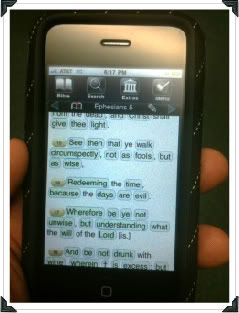
Ephesians 5:15-16, “See then that ye walk circumspectly, not as fools, but as wise, redeeming the time, because the days are evil.”

It is healthy for a soul to want to do more for God and to be in a perpetual state of personal improvement and spiritual maturity.  There are 168 hours in a week, and if you tithe your time to God as you do your monetary increase then that leaves you with nearly 17 hours a week that you can dedicate solely to God.

Assuming you are faithful in your church attendance, an average service is 2 hours, then you have 11 hours left to invest in your relationship with God in a week, and the real question becomes: "What do you do with these 11 hours of great Spiritual potential?"  Consider these suggestions:


1.      Pray.  You don't have to start out praying an hour a day, but whatever time you invest in prayer will bring results.  Prayer is essential to growing in the Lord.  Learn to intercede, but don't let intercession overwhelm you and rob you of joy.


2.      Read.  Read the Word of God.  Some people spend so much time studying and chasing down rabbit tracks in the Bible that they fail to simply read the Bible.  Pray, clear your mind, then read.  Let His written Word be as food to your spirit and absorb it. Remember: The greatest and final source of self-examination is the Word of God.


3.      Study.  This is the time to follow those rabbit trails. This is the time to look into the deeper meaning of the Scriptures. This is the time to search the Scriptures.


4.      Listen.  Invest time in active listening.  Many people talk to God in prayer, but ignore the richest half of prayer time -- listening to what Jesus is saying to them.  He hears your prayer, but do you hear His?  Prayer is dialogue, not monologue.


5.      Fast.  You want to draw closer to God? Fast one day a week, one meal a day, or three days (typically, 3 days is what it takes to crucify the flesh). You can also fast by setting aside time spent on things that you enjoy (other than food), like the Internet, movies, Starbucks, chocolate, etc.


6.      Praise.  There needs to be some time in your week, or day, where you loudly and demonstratively praise God.  Dance before Him in secret prayer; sing in the Holy Ghost loudly as you're sweeping the carpet; let tears of praise flow. We praise God for what He's done. Shout! Clap! Jump! Sing! Extol!


7.     Worship.  Worship is different than praise.  Study the difference and then apply it to your life.  We worship God for who He is. Lie prostrate before God.


8.      Obey.  Whatever God tells you to do in His Word, in prayer, or by His messengers (Pastor, preachers, teachers...) do!  Remember: God will never ask/tell you to do something that violates His written Word.

Of course, there will be days when you feel like you’ve been with God all day, and others when He seems to be unavailable, but every day is full of potential investment opportunities in your relationship with your Lord and Savior Jesus Christ as you tithe your time to Him.

02 June 2010

T.W. Barnes - Saying the Name of Jesus


According to T.W. Barnes, many people pronounce the name of Jesus without really knowing how to say it. He specified four ways to say the name of Jesus:
  1. Say His name with love; the early church had great success, because they loved not their lives, they loved that Name. Love is powerful. Their love gave them reverence for the Name.
  2. Say His name with vision. Say it seeing the invisible. A woman said, "I resist the devil and he doesn't leave." Bro. Barnes asked her, "What do you look for? The Bible doesn't say resist him and see him sitting on your shoulder; when you resist him you should see him running. The devil no doubt left you when you said in Jesus Name, but since you did not expect him to go, your thinking made you as miserable as if he stayed with you."
  3. Say His name with faith. Religious leaders in Israel asked the disciples, "How did you heal the man crippled from his mother's womb?" Peter answered, "...by the name of Jesus Christ..."
  4. Say His name while living a life of sacrifice. The disciples sacrificed everything for that name. We need to love it enough that no sacrifice is too great to make for Jesus.
-Nona Freeman, A Prophet in our Time (2007)
 
********************************
 
 
Why is there so much power in the Name of Jesus?  T.W. Barnes attributed it to the following reasons: 
  1. His Word is in itJohn 1:1, “In the beginning was the Word…”
  2. His Blood is in it – Jesus is a blood name that redeems all people from sin and the effects of sin (sickness, disease, mental disorders, etc.).
  3. His Spirit is in it – The Holy Ghost that you received when you spoke in tongues the first time is that Spirit of Christ in you.
  4. The authority of heaven is in it – All power in Heaven and earth belongs to Jesus Christ.
  5. His faith is in it – He made everything by the power of His own Word; He spoke it and it happened.
-Nona Freeman, A Prophet In Our Time (2007)

25 December 2009

Water Baptized

I hope you have a blessed Christmas! Along with that blessing, I can’t think of any greater gift to give you on Christmas Day than the great blblical truth of the only way to be born again.

It's the way the Apostles were taught by our Lord Jesus Christ, the only way they taught others, and the only way we can be converted today.

Understanding the Word of God

Your Soul


The Holy Ghost

26 August 2009

Adrian Rogers Offers Five Reasons We Can Trust the Bible

A friend sent me this today and I like it so much I'm going to post it here.

What evidence is there that the Bible is in fact God's Word?[1]
By: Adrian Rogers

I want to give you five reasons to affirm the Bible is the Word of God.

First, I believe the Bible is the Word of God because of its scientific accuracy. The Truth of the Word of God tells us that God “hangeth the earth upon nothing” (Job 26:7). How did Job know that the earth hung in space before the age of modern astronomy and space travel? The Holy Spirit told him. The scientists of Isaiah’s day didn’t know the topography of the earth, but Isaiah said, “It is [God] that sitteth upon the circle of the earth” (Isaiah 40:22). The word for “circle” here means a globe or sphere. How did Isaiah know that God say upon the circle of the earth? By divine inspiration.


Secondly, the Bible is affirmed through historical accuracy. Do you remember the story about the handwriting on the wall that is found in the fifth chapter of Daniel? Belshazzar hosted a feast with a thousand of his lords and ladies. Suddenly, a gruesome hand appeared out of nowhere and began to write on a wall. The king was disturbed and asked for someone to interpret the writing. Daniel was found and gave the interpretation. After the interpretation, “Then commanded Belshazzar, and they clothed Daniel with scarlet, and put a chain of gold about his neck, and made a proclamation concerning him, that he should be the third ruler in the kingdom.” (Daniel 5:29). Basing their opinion on Babylonian records, the historians claim this never happened. According to the records, the last king of Babylon was not Belshazzar, but a man named Nabonidas. And so, they said, the Bible is in error. There wasn’t a record of a king named Belshazzar. Well, the spades of archeologists continued to do their work. In 1853, an inscription was found on a cornerstone of a temple built by Nabonidas, to the god Ur, which read: “May I, Nabonidas, king of Babylon, not sin against thee. And may reverence for thee dwell in the heart of Belshazzar, my first-born favorite son.” From other inscriptions, it was learned that Belshazzar and Nabonidas were co-regents. Nabonidas traveled while Belshazzar stayed home to run the kingdom. Now that we know that Belshazzar and Nabonidas were co-regents, it makes sense that Belshazzar would say that Daniel would be the third ruler. What a marvelous nugget of truth tucked away in the Word of God!


Third, from Genesis to Revelation, the Bible reads as one book. And there is incredible unity to the Bible. The Bible is one book, and yet it is made up of 66 books, was written by at least 40 different authors over a period of about 1600 years, in 13 different countries and on three different continents. It was written in at least three different languages by people in all professions. The Bible forms one beautiful temple of truth that does not contradict itself theologically, morally, ethically, doctrinally, scientifically, historically, or in any other way.


Fourth, did you know the Bible is the only book in the world that has accurate prophecy? When you read the prophecies of the Bible, you simply have to stand back in awe. There are over 300 precise prophecies that deal with the Lord Jesus Christ in the Old Testament that are fulfilled in the New Testament. To say that these are fulfilled by chance is an astronomical impossibility.


Finally, the Bible is not a book of the month, but the Book of the ages. First Peter 1:25 says: “But the word of the Lord endureth for ever. And this is the Word which by the gospel is preached unto you.” No book has ever had as much opposition as the Bible. Men have laughed at it, scorned it, burned it, ridiculed it, and made laws against it. But the Word of God has survived. And it is applicable today as much as it was yesterday and will be tomorrow.
It’s so majestically deep that scholars could swim and never touch the bottom. Yet so wonderfully shallow that a little child could come and get a drink of water without fear of drowning. That is God’s precious, holy Word. The Word of God. Know it. Believe it. It is True.


[1] SOURCE: http://bible.christianity.com/11542346/ ACCESSED: 8/26/2009

29 January 2009

The Quantum Leap


Today I am posting an article written by Leon Golden. Leon is a senior at IUPUI pursuing a Bachelor of Science in Mechanical Engineering, a member of Moriah Apostolic Church, and one of my dearest friends.


The Quantum Leap
By: Leon Golden

The rapture, the catching-away, the Lord’s return for His saints, whatever you choose to call it, Christians have been eagerly anticipating this day for nearly two-thousand years. A day when the bodies of those who have truly served God will be instantaneously changed from their natural, physical state, to another “glorious” structure. When you stop and ponder the idea of the rapture, as I will call it, it does appear to be a somewhat ridiculous idea. Many church denominations have given up the idea of a literal “rapture” and viewed the Bible through more humanistic eyes. However, the idea may not be as farfetched as it initially appears. It is this author’s belief that the natural world offers models as well as clues as to the nature and mind of God, bearing in mind that we ourselves are fearfully and wonderfully made. Let’s observe a phenomenon recently discovered (within the last 75 years) by scientists, known as the quantum leap.


Requisite Knowledge


Scripture for consideration: Through faith we understand that the worlds were framed by the word of God, so that things which are seen were not made of things which do appear. (Hebrews 11:3)


The physical things that we see are made up of cells, which can be reduced to individual molecules, which can be further decomposed into atoms. The atom is the smallest elementary unit in which a substance can be broken down into and still retain its identity. In the center of the atom there is the nucleus about which the electrons orbit at an incredible speed. The electron is held in orbit by an electromagnetic force which keeps it as close to the nucleus as its energy will allow it to get. For example, the more energy an electron possesses, the further it can orbit from the nucleus. Only a certain number of electrons can orbit a given energy level, after which they must move to a higher level – in general, the lower energy levels must be filled first.


The concept of a quantum leap stems from the field of quantum mechanics, which is the branch of science that studies the motion and behavior (the mechanics) of atoms.


Nearly every crevice of the universe is constantly bombarded by electromagnetic radiation (light). As this radiation interacts with the electrons, which are the building blocks of matter, some amazing things happen. The electrons absorb and release little “packets” of energy as they interact with the electromagnetic radiation. Of course, as the electron momentarily absorbs this energy, it moves temporarily to a higher energy level and subsequently moves back to a lower energy level as it releases this “borrowed” energy. It is this interaction that commands awe and produces the phenomena called the quantum leap.


Consider the following illustration: If you want to get from your house to the end of the driveway, there is a period of transition, i.e. you must walk from point A to point B. There is a short period of time in which you are between the two places. In contrast, as the electrons absorb and release energy, there is no transition. The electron in the lower energy level “pops” out of existence and instantaneously “pops” into existence at the higher energy level – this is known as a quantum leap.


This concept is a perfect natural model of the rapture of the Church. It does appear to be a completely ridiculous idea, but is nonetheless truth. One day, we will “pop” out of existence on this earth and instantaneously “pop” into existence at a higher energy level.

20 March 2008

The Gift


It's been a few months since I wrote anything, but I was researching something today for a Bible lesson I'm teaching tonight at Landmark Bible Church in Rockport, IN. While searching for one thing I unearthed an old email to an Internet acquaintance I met a few years back. Here's a response to that fellow minister in the Gospel, which I've edited for this blog. God bless you all as you receive the free gift.


“A gift, to be a gift, has to be accepted. Otherwise it lies like a burden between people.”
–Robert Fisher, The Knight In Rusty Armor

I think that we are too casual in explaining the present of the Holy Ghost. Since it is in fact the Spirit of Christ in us, it is no wonder that He would be grieved by those who would not want Him in them. I think of those in the nominal church world who have the same access to the Holy Ghost as all of us in this age of grace and Holy Ghost outpouring, but who merely put it on a shelf and never unwrap it. The gift then lies unwrapped, unaccepted, and a burden.

My first date occurred at a banquet on February 14th, when I was twelve years old. I gave the young lady a present that night, which she accepted. However, later that evening, as she was preparing to go home, I misunderstood something she said. She wanted to go get her present, but I thought that she was saying something else. Consequently, she thought that I was refusing to let her keep the gift. To this day I think she still has little time for me and that event is a burden between two individuals.

LOL!! What a catastrophe!?!?

God is not like that. He not only gives a gift, but He never takes it back and He always knows exactly what we communicate - even when we don't know how or what to say.

My grandfather began his journey towards God in the late 1940s. He had such an experience in repentance that he received the joy that the Samaritans had in Acts 8, but he had not received the Holy Ghost. His wife then met some Pentecostals and received the Holy Spirit. Grandpa would get upset with her at night because she spoke in tongues before going to bed at night and insisted that he needed more than what he had. It lay as a burden between them. Finally, Grandpa prayed to God and said that he knew he had all that God had for him, but to make his wife happy, would God let him speak in tongues. Instantly, the presence of God that he'd felt since his repentance left him. This was when he knew that God had more for him - it lay as a burden between him and God. He then cried out in repentance for His pride and God filled him with the Holy Ghost speaking in tongues.

Salvation is a gift that unless received in totality will be forfeit no matter who we are. Paul wrote about receiving the abundance of grace and the gift of righteousness, which is only accessible through Jesus Christ, who is our portion and free gift through grace. (Ro. 5:21). Refusal of this gift, in this particular text, results in the refusal of eternal life.

Paul also wrote of the gift he was given charge of by the churches of Macedonia, who gave it to bless the Corinthian church (2 Cor. 8). I imagine that if this gift had been refused that there would have been ought among these two groups.

Unrequited love is often mentioned in literature and even God Himself is mentioned by some as a jilted lover covering His eyes in grief as His Jewish bride rejects Him and He then turns to the Gentiles for succor. I only know that He wept at their obtuseness and they became a people who had eyes but did not see. This rejection of Jesus still lies as a burden between God and the nation of Israel as a whole, but, praise God, Israel did not stumble to fall. I believe that the burden will be lifted when they look on Him whom they pierced and acknowledge Him as Messiah.

We call it the gift of the Holy Ghost and it is, by one man’s estimation, being received by 35,000 people a day throughout the world. Why wouldn’t people want to receive this phenomenon that Christ has paid for with His blood and made available to all people?